

Mia-yaltwa Ha’lidzogm hoon: Protecting the Central Coast
Six Partner Nations, Canada and British Columbia are working together to protect extraordinary marine ecosystems while supporting thriving coastal communities and sustainable marine livelihoods.

What is Mia-yaltwa Ha’lidzogm hoon?
Mia-yaltwa Ha’lidzogm hoon (pronunciation: Me-ah-yall-twa Ha-lee-joh-gom hOH-ownis) is an Indigenous Protected and Conserved Area (IPCA) and National Marine Conservation Area Reserve (NMCAR) on British Columbia’s Central Coast. Together, these designations demonstrate First Nation leadership, collaborative governance, long-term marine conservation and sustainable marine use.
The name is a hybrid place name created from the languages of the six partner Nations and means “Realm of the Salmon, World of the Salmon.”
The name reflects the deep cultural, ecological and spiritual importance of salmon to the Wuikinuxv, Nuxalk, Kitasoo Xai’xais, Heiltsuk, Gitxaała and Gitga’at Nations, and symbolizes the Nations coming together in shared purpose to protect and steward these waters.
Why it Matters
HEALTHY OCEANS
These waters support salmon, whales, herring, kelp forests, seabirds, coral and sponge reefs.
HEALTHY COMMUNITIES
Healthy oceans support food security, cultures, fisheries, tourism, recreation and local economies.
FUTURE GENERATIONS
Protecting these waters today helps sustain resilient ecosystems facing multiple threats, such as climate change, and coastal communities tomorrow.

Shared Vision for Marine Protection
Mia-yaltwa Ha’lidzogm hoon brings together partnering Nation leadership, knowledge and stewardship responsibilities with Parks Canada and British Columbia. Future decisions will be guided collaboratively through management planning, a management board and advisory input from communities, marine sectors and stakeholders.
What Happens Next?
NOW
Establishment Agreement signed on May 22, 2026
NEXT
Management board and advisory committee created
THEN
Management planning begins
ONGOING
Community and stakeholder engagement
LONG TERM
Collaborative implementation and operations
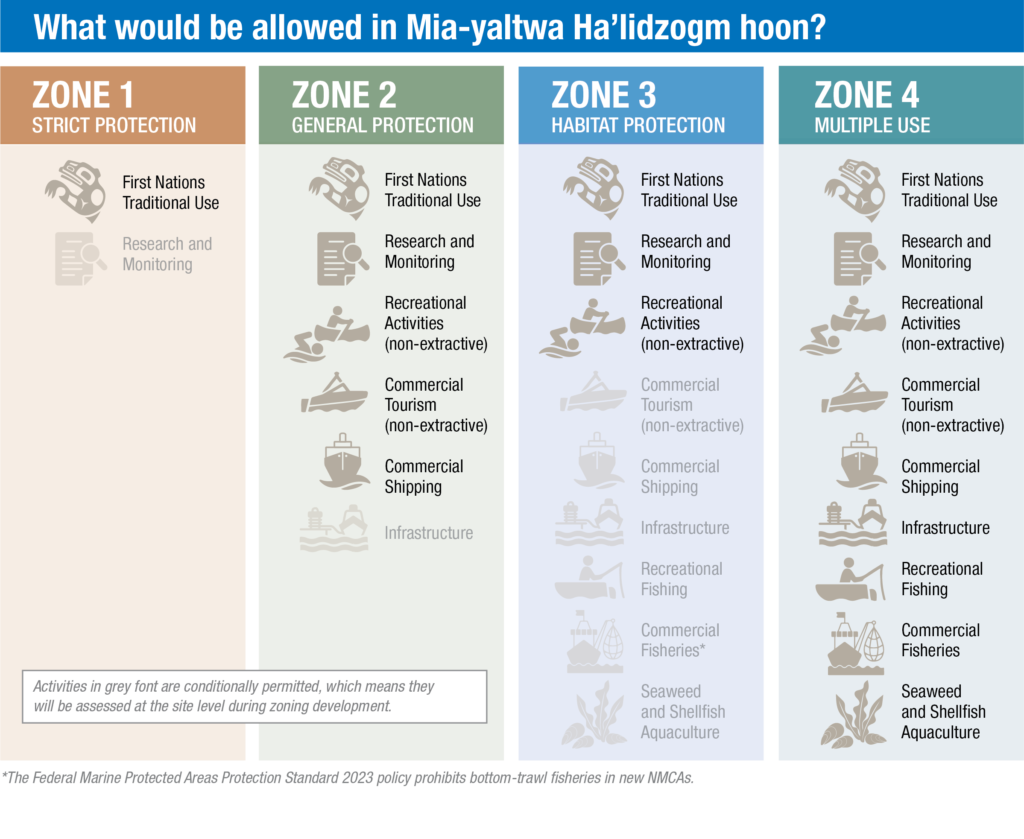
What Activities can Continue?
Mia-yaltwa Ha’lidzogm hoon is not a blanket closure. Future management planning will determine where zones are places, working to balance conservation with sustainable marine use.
Frequently Asked Questions

Want to Learn More?
If you have any questions about this groundbreaking initiative, please contact us or sign up for our newsletter by clicking the button below.